New Tires & Tire Repair
REQUEST APPOINTMENT
You need new tires, and you have questions. What type of tire do I really need? What do terms like “all-season” and “all-terrain” really mean? What are my financing options?
Midas brings simplicity to tire buying (and owning). We’re here to help you with tire selection, financing, professional installation, and preventive maintenance for a long tire life. We even check your tire pressure and tread wear as part of every Midas Closer Look Vehicle Check™ 1 , no matter what auto repair or maintenance service brings you to Midas.
Frequently Asked Questions
Free Tire Care, Along With Flat Repairs or Replacements.
When you buy tires at Midas, you get complimentary maintenance every 5,000 miles (8,000 km) in the form of tire rotations, rebalancing, air pressure checks and inspection for irregular wear. And if the tire is ever unrepairable due to road hazards, we’ll fix it or replace it for free.
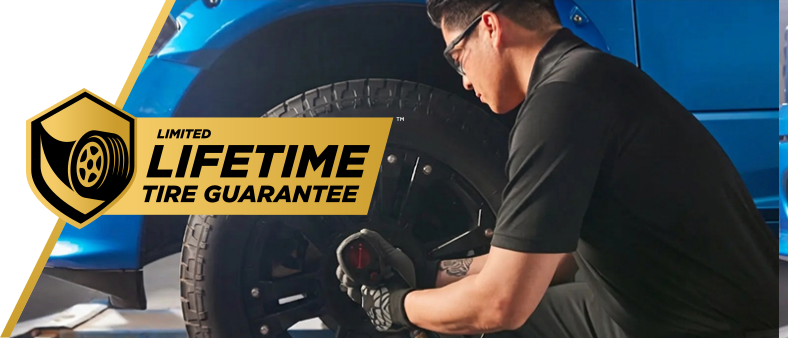
The Limited Lifetime Tire Guarantee™ ² lasts for as long as you own your vehicle, or for the useful life of your tires.
Seasonal Tires - Change these tires twice a year for the best possible tire performance in summer and winter.
Snow/Winter Tires: The strongest possible winter traction thanks to tread edges that bite into ice and snow, generous channels that send away slush -- and rubber that stays supple at lower temperatures than other tires.
Summer Tires: Lower rolling resistance (and less fuel consumption) than winter, all-season, or off-road tires thanks to flatter treads (for more road contact) -- and rubber formulated for warmer temperatures.
Related: When to switch between summer and winter tires
Year-Round Tires - Not into changing tires along with the seasons? These versatile tires balance the features needed for summer and winter driving, on and off the roads.
All-Season Tires: The tires that come with most passenger cars. Ideal for street driving in areas where winters are moderate (at worst).
All-Terrain Tires: Multipurpose marvels that balance off-road traction and durability with comfortable, responsive highway handling. Ideal for a mixture of street driving and moderate off-road use.
Mud Tires: Off-road specialists that power through mud, rocks, sand, dirt, and deep snow. Ideal for primarily off-road use (especially on challenging terrain).
Low Profile Tires: Enhanced cornering and handling thanks to wide treads and short sidewalls.
Performance Tires: Excellent traction, maneuverability and performance thanks to soft rubber compounds and stiff sidewalls.
Want the best snow traction in a year-round tire?
Look for the three-peak mountain snowflake (3PMSF) symbol on tires rated for severe snow service. To qualify, a tire must achieve 10% better traction over medium packed snow in manufacturer tests. The mountain snowflake symbol is found on most dedicated snow tires -- and select (year-round) all-terrain and all-season tires. Learn more about severe snow-rated tires.
You should replace any tire that shows one or more of these signs of age, damage, or wear:
Low tread depth: Replace tires that have worn down below the recommended tread depth. The U.S. legal minimum tread depth is 2/32.” You may want to replace your tires at a higher tread depth depending on manufacturer recommendations, or your specific driving conditions.
Sidewall damage: Tires with cracks, punctures, blisters, or bulges in the sidewall are no longer structurally sound and cannot be repaired.
Your local Midas technician can help you identify these tire safety hazards, and help you select your perfect replacement tires.
At what tread depth should tires be replaced?
The legal minimum tire tread depth in the United States is 2/32” and many tire experts recommend replacing tires at 4/32”-6/32” tread depth or less, especially for tire types that benefit from a deeper tread (snow tires, all-terrain tires, or mud tires). Testing multiple winter tire brands at 5/32”-6/32” tread depth (or 50% of original tread depth), Consumer Reports saw a 14.5% decline in snow traction when accelerating, and a 7% increase in wet stopping distance compared to the tires’ original tread depth ³ .
How to tell if your tire tread depth is too low, and you need to replace your tires:
Use a tire tread depth gauge for a precise measurement.
Take the U.S. Penny Test: Insert a penny (head first) into your tire tread. If you can see the top of Lincoln’s head, it’s time for new tires. If the top of Lincoln’s head is covered, your tread is deeper than 2/32”. On the tail side, if the top of the Lincoln Memorial is covered, your tread is deeper than 6/32”.
Take the Canadian nickel test: If the top of Queen Elizabeth’s crown is covered, your tread is deeper than 2/32”.
Take the U.S. Quarter Test: If the top of Washington’s head is covered, your tire tread is deeper than 4/32”.
Take the Canadian Quarter Test: If the caribou’s nose is covered, your tire tread is deeper than 6/32”.
Check the wear bars: Tire wear bars are situated at 2/32” of tread depth, so if any wear bar is worn, replace the tire right away. It’s below the legal minimum tread depth.
Check tread depth on several parts of the tire, especially if you see uneven wear patterns. And talk to a Midas tire expert to help you decide how low your tread depth can go.
It’s a good idea to have your wheel alignment checked when you buy new tires, to ensure that your new tires wear down evenly from the day you drive them home. We also recommend having your alignment checked regularly to extend the life of your tires -- it’s especially convenient to do this when your vehicle is in for services like tire rotation.
While tire imbalance is a common side effect of bumpy roads and other driving hazards, new tires should be checked for balance before mounting. Even new tires can have natural imbalance from the factory. Starting off with balanced tires and having the balanced checked as a regular part of tire service will help extend the life of your tires.
Midas recommends installing a TPMS Service Kit with every tire purchased on a TPMS sensor vehicle and testing the TPMS sensor to ensure it’s measuring your tire pressure correctly. Maintaining proper tire pressure extends the life of your tires by preventing premature edge wear and other damage. And your TPMS system is there to alert you to dangerously low tire pressure -- and the blowout risk it brings. You don’t want to miss this warning due to incorrect pressure measurements or a malfunction in your TPMS’s alert function.
Learn More
All-Terrain Tires
What if you need off-road capability, but you do plenty of road driving too? Mud tires can tackle the terrain, but it’ll be a bumpy ride home on the highway. Highway tires offer a comfy commute, but they’re no match for the mountain.
Learn MoreFlat Tire Repair
If you’ve ever had a flat tire, you know two sinking feelings: The flat itself and the thought of having to replace a tire before its time. But as much as we love selling new tires, it’s not ideal to replace one tire at a time. If your tire can be repaired, it’s better to fix it and keep the set together for a long and useful life. We’re here to help you keep those tires as long as possible -- and select your next set when the time comes.
Learn MoreSnow Tires
Here's an all-too familiar winter driving scene: the roads are dusted with slippery, powdery snow and the all-season tires that came with your car seem to be getting the job done. Until your back wheels start to fishtail. Or you brake for a traffic light -- and your car keeps rolling (skating?) toward that icy intersection for several more seconds.
Learn MoreTire Balancing
Has your steering wheel started to vibrate just as you hit the speed limit? Then it’s time to have a mechanic check your…tires? Actually, yes. Vibrations at a specific range of highway speeds are a classic symptom of tire imbalance, and the effect is often first felt in the steering wheel. And that’s just the beginning. Left untreated, an unbalanced tire can shorten your tire life, increase your fuel cost, and eventually damage your shock absorbers, wheel bearings, and wheel assembly. And your ride will get more bumpy -- and more dangerous. So be sure to have your tires inspected at the first sign you might need tire balancing.
Learn More1 Midas Closer Look Vehicle Check™ also includes visual checks of brakes, battery, air filter, fluids, belts, and hoses.
2 Most vehicles. The Midas Limited Lifetime Tire Guarantee™ is valid on all passenger or light truck tires purchased with paid installation from a participating Midas location. Free flat repair or replacement valid for as long as you own your car or down to 3/32nd remaining tread. Covers eligible damaged tire resulting from road hazards (e.g., nails, potholes, debris, etc.) Taxes, mounting, balancing, and any other miscellaneous fees are an extra charge. Includes free tire rotation and re-balance every 5,000 miles 8 000 km , tire air pressure checks, alignment checks, and inspection for irregular tire wear. TPMS reset is an extra charge. See store prior to rotation to determine reset requirement. Shop fees additional, see store for details and applicability. No cash value. Charge for additional parts and services if needed. Valid at participating locations.
3 Consumer Reports tested 50 models of winter tires after removing 50% of tread from the tires (resulting in testing tread depths of 5/32”-6/32”), and published the results on February 10, 2018.